National EoE Awareness Week
This week (August 6–12) marks National EoE Awareness Week, a campaign aimed at raising awareness of eosinophilic gastrointestinal diseases (EGIDs), including eosinophilic esophagitis (EoE) – a little-known but potentially debilitating condition affecting swallowing and digestion.
EoE is caused by inflammation in the oesophagus, often triggered by an allergic reaction to food or environmental factors. Symptoms can include difficulty swallowing, choking or gagging on food, food regurgitation, nausea, vomiting, reflux, and stomach or chest pain. In severe cases, food can become stuck in the oesophagus entirely.
Diagnosis is frequently delayed, with endoscopy and biopsy the only definitive way to confirm the condition. Around 75 per cent of people with EoE also live with other allergic conditions such as asthma or allergic rhinitis, and for some, symptoms flare only in spring when exposed to pollen.
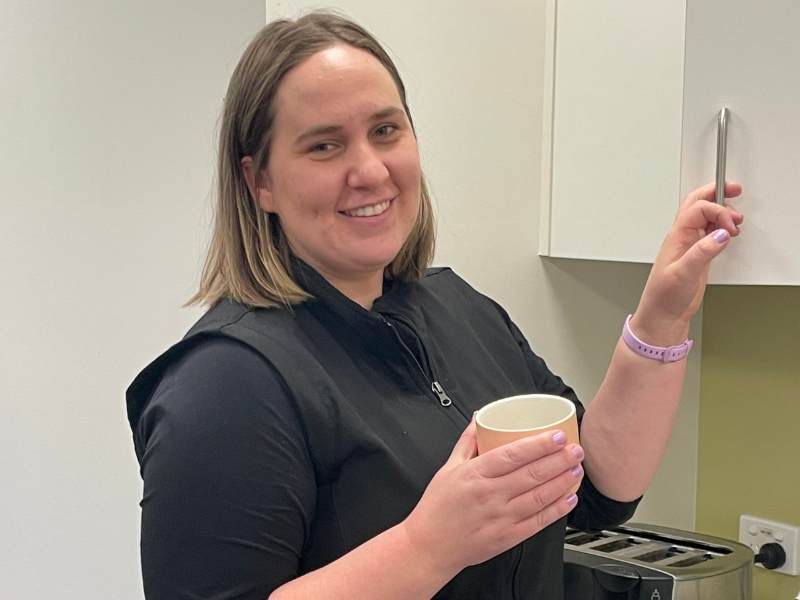
For Bellarine Community Health (BCH) staffer Laura, the diagnosis came after a lifetime of unexplained symptoms.
Laura had surgery to remove an obstruction in her oesophagus at just 16 years old, and again in her mid-thirties, with the second surgery finally leading to an EoE diagnosis, roughly 18 months ago.
“You’re telling me. All these years, like, 20 years ago, I had this surgery, and now I’m having to have it again, and in between those two surgeries, they discovered that condition, EoE,” Laura said.
Laura believes her triggers are largely environmental and now manages the condition with steroid medication. Before her diagnosis, she developed her own ways of coping with symptoms.
“I’d be eating food, I’d get food stuck, I’d have to spit up what I was eating. I just avoided some foods because I knew there was a bit of a trigger there, or I’d eat more of particular foods, like softer foods, like desserts, because I could eat those really easily, whereas if it was meat or chips or anything like that, I’d be like, I know what’s going to happen. It’s just going to get stuck,” she said.
Having never known what it felt like to swallow properly, Laura watched her own children closely at mealtimes and stuck to pureed food out of fear something similar might affect them too.
Since starting treatment, Laura says her quality of life has changed dramatically.
“I don’t have to worry about what I’m eating. I can just swallow. It sounds ridiculous. I can drink water. I can just eat. The first time I was able to properly eat after I started the steroids, I was like, are you kidding? Is this how normal people swallow and eat?” she said.
The role of Dietitians in managing EoE
Most people with EoE are co-managed by a medical specialist and a specialist Dietitian, with treatment often combining medication and dietary management.
Elimination diets are commonly used to help identify the specific food triggers causing inflammation in the oesophagus. Accredited Practising Dietitians, like those at Bellarine Community Health, work alongside specialist gastroenterologists to support investigation and diagnosis, and to help design an individualised treatment plan for each patient.
Elimination diets can carry nutritional risks for certain groups, particularly children and teenagers, people with chronic diseases, or those with other dietary restrictions already in place.
BCH Dietitians play a key role in ensuring patients continue to meet their energy and nutrient needs during this process, recommending appropriate substitutions and dietary replacements – whether during a short-term elimination phase or where longer-term food avoidance is required.
Laura is speaking publicly about her experience in the hope of helping others recognise the signs of EoE and seek support.
“I want people to know that it does exist and that it’s an actual condition. There are probably way more people affected by it in the community than we realise, and people probably just put up with it. There is an actual treatment for it that can change your life,” she said.
For more information about EoE, go to https://www.allergy.org.au/patients/food-other-adverse-reactions or dietetic support available through Bellarine Community Health https://bch.org.au/dietetics/